
Portable Generator Safety: Placement, CO Shutoff and Wiring

Portable generator safety comes down to one decision made badly, usually in the dark. The machine gets moved somewhere convenient instead of somewhere safe, and convenient almost always means closer to the house. That single choice is behind most of the deaths, and it is entirely preventable.
This guide covers where a generator must go, how far away, what the exhaust does, how to connect it without endangering line workers, and how to tell whether the unit you own has the shutoff technology that would save you if something went wrong. The numbers come from federal safety data rather than from opinion.
Last reviewed and updated: October 8, 2026. How this guide was researched: this portable generator safety guide is desk research, not a product test. Fatality data comes from the U.S. Consumer Product Safety Commission, placement guidance from CPSC and the Centers for Disease Control and Prevention, shutoff requirements from the ANSI/PGMA G300 and ANSI/UL 2201 voluntary standards, and wiring rules from the National Electrical Code. We did not test any generator, and nothing here is a hands-on review.
Portable generator safety: the short version
If you read nothing else about portable generator safety, read this. Run the generator outdoors only, at least 20 feet from the house, with the exhaust pointed away from any building. Never run it in a garage, a basement, a crawlspace, a shed or an enclosed carport, and an open door does not change that. Fit working carbon monoxide alarms on every level of your home. Never plug a generator into a wall outlet.
Everything below is the reasoning behind those rules, plus the details that decide whether you can actually follow them when the weather is bad.
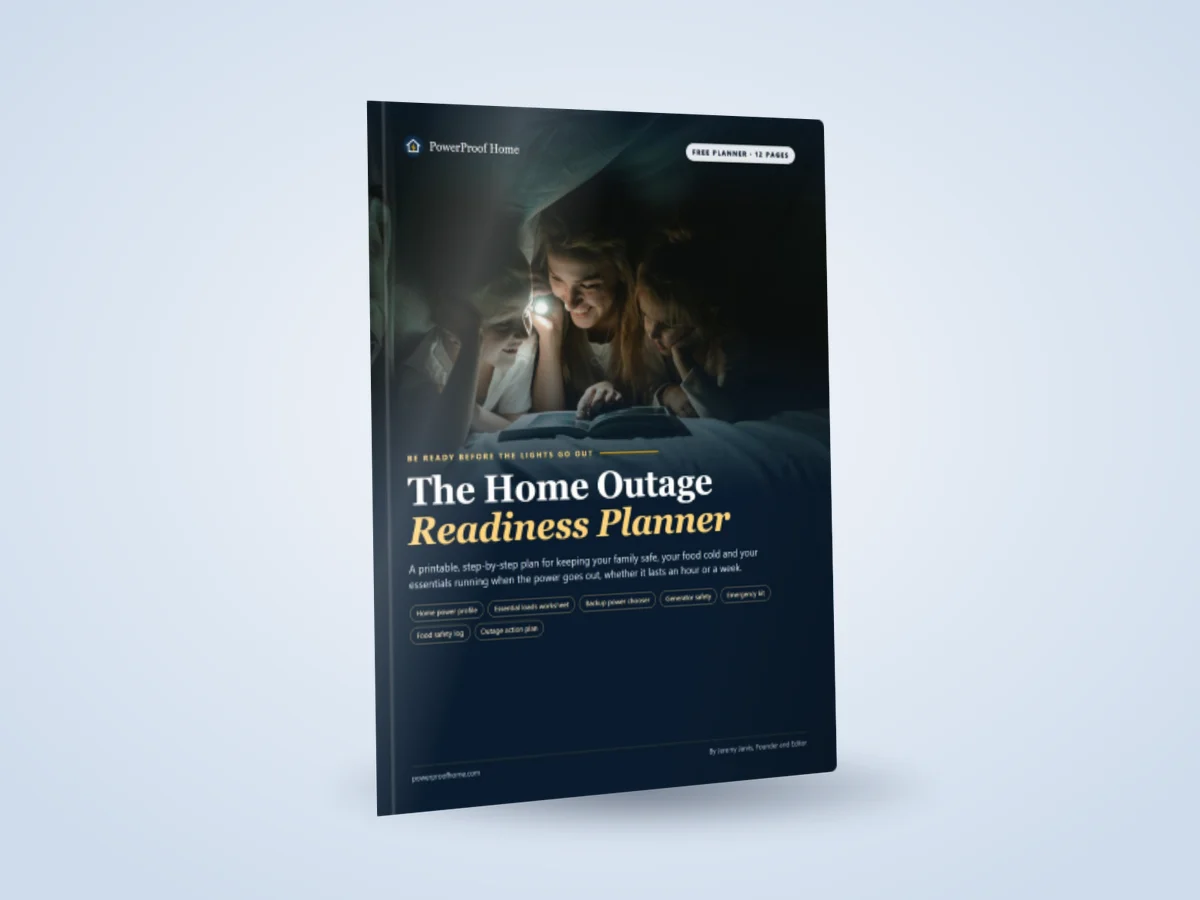
Free download: The Home Outage Readiness Planner
Our 12-page printable planner: a home power profile, essential loads worksheet, backup power chooser, safety rules, emergency kit and food safety log.
Why carbon monoxide is the hazard that actually kills
Portable generator safety is usually discussed in terms of electrocution and fire, but exhaust is what fills the casualty figures. Carbon monoxide is colourless, odourless and gives no warning. A generator produces it continuously while running.
The U.S. Consumer Product Safety Commission reports that portable generators have been associated with an estimated 765 non-fire CO poisoning deaths since 2009, accounting for 40 percent of all CO deaths related to consumer products under the agency’s jurisdiction. For CO deaths generally, more than half occur during November, December, January and February.
CPSC’s own instruction is unusually blunt for a federal agency. Portable generators are to be used outside only, at least 20 feet from the home, and never inside a home, garage, basement, crawlspace or shed.
That list of forbidden places is the tell. Those are not exotic locations. They are the places a reasonable person puts a machine to keep it out of the rain, or quiet enough not to annoy neighbours, or close enough that the cord reaches. Portable generator safety fails at exactly those moments of practical compromise, which is why the placement decision has to be made in advance rather than in the dark.

How far from the house should a generator be?
CPSC states the rule plainly: outside only, at least 20 feet from the home. That distance is not arbitrary. It exists because exhaust drifts, and because wind can push it back toward a structure.
There is a practical corollary that most people miss. Your cord has to be long enough to span that distance with slack to spare. If it is not, the cord will quietly decide your placement for you, and it will decide wrong, because the machine gets dragged toward the house until it reaches. Measure the run and buy the cord before the storm, not during it.
Three more placement rules matter as much as the distance:
- Point the exhaust away from your home and from any neighbouring building someone could be inside.
- Keep the unit clear of windows, doors, vents and air-conditioning intakes, which draw air inward.
- Do not tuck it against a wall or into a corner, because the structure traps and concentrates exhaust.
Finally, fit CO alarms. Put them on every level of the house, test them, and replace them on schedule. They are the last line of defence if placement goes wrong, and they are the cheapest part of the entire system.
The CO shutoff standards, and how to tell if your generator has one
This is the part of portable generator safety that has changed most, and it is worth knowing before you buy. Two voluntary industry standards now require a generator to shut itself off when carbon monoxide builds up near it.
| Standard | What it requires | CPSC staff estimate of deaths averted |
|---|---|---|
| ANSI/UL 2201-2018 | Automatic shutoff plus a reduced CO emission rate | Nearly 100 percent |
| ANSI/PGMA G300-2018 | Automatic shutoff plus user notification after shutdown | Nearly 87 percent |
Under UL 2201 the generator must stop when CO reaches 400 ppm, or when the rolling ten-minute average exceeds 150 ppm. PGMA G300 requires the shutoff and adds notification, but does not require the lower emission rate, which is why CPSC staff rated it slightly less effective.
Two caveats keep this honest. First, both standards are voluntary. CPSC staff recommended proceeding with mandatory rulemaking in 2022, and you should check the agency’s current position rather than assume a rule exists. Second, compliance has been limited, so many units on sale and most units already in garages have no shutoff at all.
Check the packaging and the product description for the standard mark before buying. And treat the feature as a backstop, not a licence: a shutoff is designed to save you when placement has already failed.
Where a generator must never go
The portable generator safety rule is simple to state. A generator runs outdoors, full stop. The table below covers the places people put them anyway, and why each one fails.
| Location | Why it is unsafe |
|---|---|
| Garage, door open | Exhaust still accumulates and migrates into the house. This is one of the most common fatal scenarios. |
| Basement or crawlspace | No meaningful air exchange, and the exhaust is already inside the envelope. |
| Enclosed carport or breezeway | Partial enclosure traps exhaust while feeling open. |
| Shed or outbuilding | Small volume, poor ventilation, and often a fuel store as well. |
| Porch or against an exterior wall | Too close to doors, windows and vents, and the wall deflects exhaust back. |
| Under a deck or overhang | Exhaust collects beneath the structure instead of dispersing. |
Rain is the usual reason people break this rule. The answer is a purpose-made generator cover or canopy that shelters the unit while leaving it fully outdoors and ventilated. It is not a tarp draped over a hot engine, which is a fire risk in its own right.
Electrical safety: backfeeding and transfer switches
The second portable generator safety hazard is electrical, and it reaches beyond your property. Plugging a generator into a wall outlet, sometimes called a suicide cord, energises your household wiring and can push power back onto the utility lines. That endangers line workers who believe the circuit is dead, and it can destroy your generator when power returns.
The National Electrical Code addresses this in Article 702, which covers optional standby systems. Section 702.6 requires transfer equipment designed so the normal and alternate sources cannot be interconnected during transfer, and a transfer switch is required where a fixed or portable standby generator connects to premises wiring. Article 702.4 governs the load calculation, and 702.10 covers grounding for portable units. Code editions vary by jurisdiction, so confirm which one applies locally and use a licensed electrician.
In practice you have three legitimate options:
- Extension cords only. No connection to house wiring at all. Safe and cheap, but limited to what a cord reaches, and it will not run hardwired equipment.
- An interlock kit. A mechanical plate on your existing panel that makes it physically impossible to close the generator breaker and the main breaker at once. See our generator interlock kit guide.
- A transfer switch. A dedicated switch feeding selected circuits, which is the cleanest option. Start with the transfer switch selector and then the full generator transfer switch guide.
Cords, loads and what to plug in
Cord choice is a portable generator safety issue, not a convenience one. An undersized cord heats up under load, and a damaged one is a shock hazard outdoors in the wet.
- Use outdoor-rated cords with a grounding pin, and check the gauge against the load and the length.
- Longer cords need a heavier gauge, because voltage drop and heating both rise with length.
- Uncoil cords fully. A coiled cord under load traps heat.
- Inspect for cuts, cracked insulation and bent pins before every use, and retire anything damaged.
- Keep connections up off wet ground, and use a cord cover or raised block where they cross a path.
On loads, work out what you actually need rather than filling the outlets. Account for motor starting surges, which can be several times the running figure for a fridge, a well pump or an air conditioner. Our home generator size calculator and the what size generator do I need guide both walk through it, and every free tool is on the tools page.
Fuel storage and refuelling without an accident
Fuel is the hazard people handle most often, so familiarity makes it dangerous. The core rule is that petrol and hot engines do not mix.

Shut the generator down and let it cool before refuelling. Spilled petrol on a hot exhaust can ignite, and a running engine means you are pouring fuel near an ignition source. Refuel outdoors, away from the house, and wipe up any spill before restarting.
Storage needs planning well before a storm:
- Use approved fuel containers only, and store them outside living space, away from heat and appliance pilot lights.
- Store only what your local rules allow, and treat the quantity limit as a fire-safety rule rather than a formality.
- Petrol degrades. Rotate your supply or use a stabiliser, and do not rely on fuel that has sat for a year.
- Remember that filling stations need electricity to pump. In a regional outage, fuel you did not store in advance may simply be unavailable.
If fuel storage is the part you cannot manage safely, that is a genuine reason to consider a propane or dual-fuel unit, which stores more stably. Our dual fuel generator guide covers the trade-offs. If it pushes you away from combustion entirely, compare the options in generator vs battery backup.
Weather: rain, snow and flooding
Generators and water are a bad combination, and outages happen in bad weather by definition. Operating a unit in the rain without protection risks both shock and damage to the machine.
Use a canopy or cover made for the purpose, which keeps rain off while leaving the unit outdoors with airflow on all sides. Keep the generator on a dry, level surface, and never operate one standing in water. Dry your hands before touching the controls. After any flooding, have a unit inspected before you start it, because water in the windings or the fuel system is a hazard rather than an inconvenience.
Snow brings its own problem: drifting can block the exhaust and the cooling intakes. Clear the area around the unit before and during a storm, and keep the 20-foot distance even when the path is unpleasant to walk.
Maintenance so it starts when you need it
A generator that will not start is a safety problem too, because it pushes people toward improvisation at the worst time. Portable generator safety includes basic readiness.
- Run it under a modest load periodically rather than leaving it idle for years.
- Change the oil on the schedule in the manual, and check the level before each use.
- Keep the air filter clean, and replace the spark plug when the manual says so.
- Stabilise or drain fuel for storage, depending on the manufacturer’s guidance.
- Check cords, outlets and the GFCI function, if fitted, before storm season rather than during it.
Our generator maintenance guide sets out a simple schedule. If noise is pushing you to site the unit badly, read quiet generator first, because the right answer is a quieter machine, never a closer one.
A pre-storm checklist
Run through this portable generator safety checklist before the weather arrives, not during it:
- Decide and mark the generator’s outdoor location, at least 20 feet out, exhaust pointing away.
- Confirm you own an outdoor-rated cord long enough to reach from there with slack.
- Test every CO alarm in the house and replace any that are expired.
- Start the generator and run it briefly under load.
- Check oil, filter and fuel condition.
- Store fuel safely in approved containers, in the quantity your rules allow.
- Confirm how you will connect: cords, interlock or transfer switch.
- Write down your priority loads so you are not deciding at 3am.
Frequently asked questions
Can I run a generator in my garage if the door is open?
No. CPSC data shows garages, carports, basements and crawlspaces are repeated locations in fatal carbon monoxide incidents, and an open door does not provide enough air exchange. Run the generator outdoors only, at least 20 feet from the house, with the exhaust directed away from any building.
How far should a portable generator be from the house?
CPSC says outside only, at least 20 feet from the home. Make sure your extension cord can actually span that distance with slack, because a short cord drags the machine back toward the house. Keep the unit clear of windows, doors, vents and air-conditioning intakes as well.
Does a CO shutoff make a generator safe to use indoors?
No. A shutoff is a backstop for when placement has already gone wrong, not a permission to bring the machine inside. CPSC staff estimated that UL 2201 units would avert nearly 100 percent of deaths and PGMA G300 units nearly 87 percent, but both figures assume the shutoff is the last defence rather than the first.
Is it safe to plug a generator into a wall outlet?
No, and it is the one mistake that endangers people outside your home. Backfeeding energises the utility lines and can kill line workers who believe the circuit is dead. Use extension cords, an interlock kit, or a transfer switch installed by a licensed electrician.
Can I run a generator in the rain?
Not unprotected. Use a cover or canopy designed for generators, which keeps rain off while the unit stays outdoors with airflow around it. Keep it on dry level ground, never operate one standing in water, and have any flooded unit inspected before starting it.
Do I still need CO alarms if my generator stays outside?
Yes. Wind shifts, placement gets compromised, and other fuel-burning appliances in the house produce CO as well. Fit alarms on every level, test them before storm season, and replace them at the end of their rated life.
Sources and further reading
- U.S. Consumer Product Safety Commission, carbon monoxide research and statistics
- CPSC, on the G300 and UL 2201 voluntary standards and their estimated effectiveness
- EC&M, on NEC Article 702 optional standby systems
This guide is educational. Electrical work, fuel systems and permits should be handled by licensed professionals, and requirements differ by jurisdiction, so confirm the rules where you live before installing or connecting anything.
Keep planning
- Quiet Generator: What Makes a Generator Quiet and How to Compare Noise
- Generator Maintenance: A Simple Schedule That Keeps It Ready
- What Size Generator Do I Need? A Step-by-Step Sizing Guide
- Dual Fuel Generator: Gasoline vs. Propane for Home Backup
Go deeper: Backup Generators hub · Home Generator Size Calculator · Transfer Switch Selector

Written by Jeremy Jarvis
Jeremy Jarvis is the founder and editor of PowerProof Home, where he builds research-based guides and free planning tools for home backup power, energy savings and outage preparedness. He sets the site's editorial standards, checks every guide against official sources such as the U.S. Department of Energy, ENERGY STAR, Ready.gov, NFPA and manufacturer documentation, and is responsible for corrections. Jeremy also founded Eco Nomad Travel, Mind Clarity Hub, SilkHarborTravel, WanderOza Travel, Freedom Road Living and Garage Playbook, and he is the author of books on clarity, focus and practical AI, including The Power of Clarity and Digital Clarity.