
Apartments With EV Charging: A Renter’s Checklist
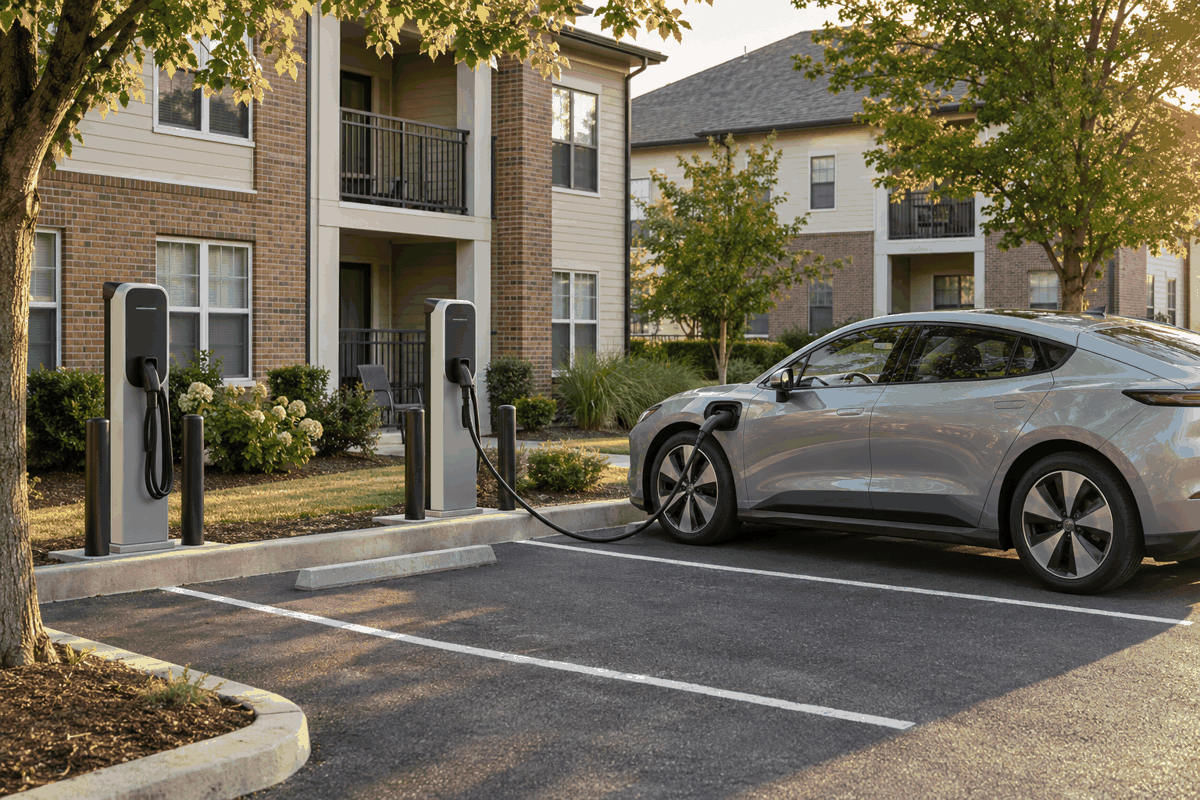
When comparing apartments with EV charging, verify that you can use the charger you see. Ask about assigned versus shared spaces, resident access, the full fee schedule, charging hours, vehicle compatibility and repair support. Get the answers in writing before signing. A listing photo or a promise of future installation does not establish a workable charging routine.
Apartments with EV charging can make daily driving simpler, but the amenity label leaves important questions unanswered. You need to know where you can park, when you can connect and what you will pay. Also consider what happens when the charger is occupied or unavailable. The useful comparison is between complete routines, not just properties that display the same icon.
This guide gives you a practical tour checklist, a cost worksheet and a message to send the leasing office. It is for renters comparing an existing charging amenity. For equipment selection and wiring questions, start with our separate Level 2 EV charger guide.
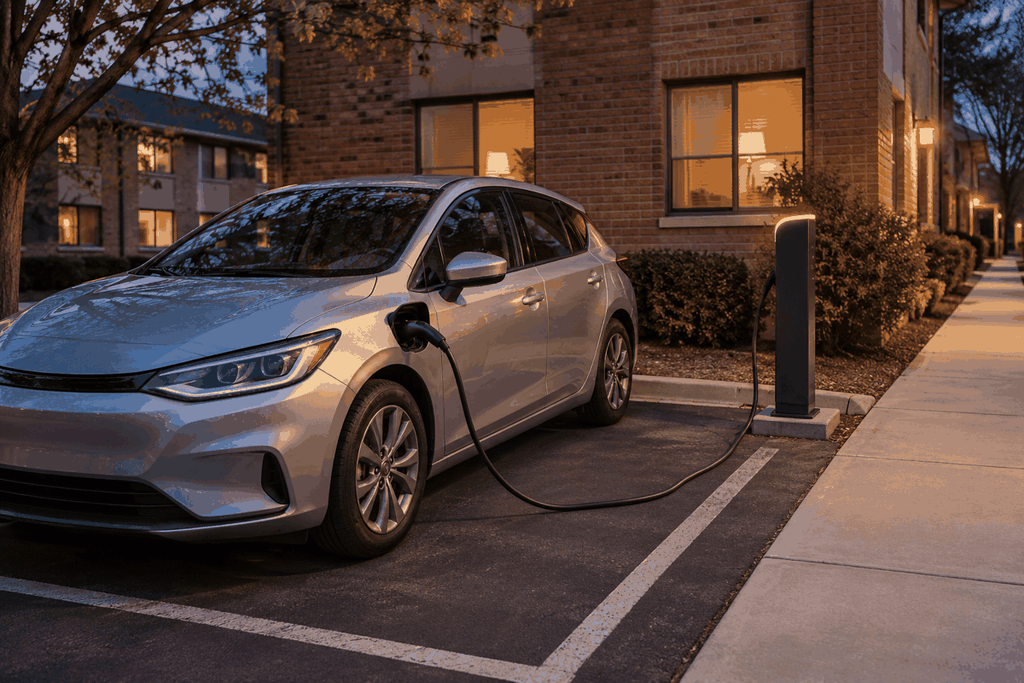
This research-based guide uses AI-assisted drafting and linked official sources. No properties or chargers were tested for this article. The photographs are AI-generated conceptual illustrations, not verified rental listings. Last reviewed: November 16, 2026. Electrical work requires qualified professionals; lease and local-rule questions belong with the property manager and an appropriate qualified adviser.
Free download: The Home Outage Readiness Planner
Our 12-page printable planner: a home power profile, essential loads worksheet, backup power chooser, safety rules, emergency kit and food safety log.
What does apartment EV charging actually include?
Start by asking the manager to describe the arrangement in plain language. Does your unit come with an assigned charging space, or do residents share a small parking area? Is equipment installed and operating now? If charging is planned, ask what access exists today and treat the future project separately.
The Department of Energy’s multifamily charging guidance identifies parking, electrical access, billing and legal issues as distinct considerations. That is why a charger photo is only a starting point. Your agreement needs to explain access to the service as well as the presence of hardware.
| Arrangement | What to verify | Decision question |
|---|---|---|
| Assigned charging space | Whether the space and charging access are included in your agreement | Can you use it during your actual parking hours? |
| Shared resident chargers | Queue, time limits, fees and rules for moving the car | Can your schedule accommodate shared access? |
| Approved outlet at a space | Written permission and professional confirmation of suitability | Does the permitted setup meet your needs? |
| Nearby public station | Access, operating hours, current fees and a backup location | Is the extra trip acceptable in your weekly routine? |
| Future installation | Current alternative and the status of the proposed work | Would you choose the apartment if the project were delayed? |
Before touring apartments with EV charging
Write down your own needs before asking about the equipment. Start with a normal week’s driving, when the car is parked and your earliest departure. Then add the unusual days that matter, such as a long commute, an evening shift or a recurring weekend trip. This makes the conversation more specific than asking whether charging is “fast.”
Also decide which constraints are firm. You might be happy to move the car after dinner but unable to do so during a night shift. Another renter may prefer a reserved space even if it costs more. These are personal tradeoffs; a generic apartment ranking cannot settle them for you.
- Record your usual weekly driving and any predictable longer days.
- List the times you normally arrive home and leave again.
- Identify your vehicle’s charging connection and manufacturer instructions.
- Decide whether moving between parking spaces fits your routine.
- Set a total housing-and-charging budget, including any parking charge.
- Choose a workable backup location before relying on one building.
Check charging access at the time you need it
Ask to see the charging area during your tour. Next, ask how access works after the leasing office closes. A gate, resident account or parking permit may be part of the process. Request a demonstration of the normal sign-up steps without sharing private account credentials or starting an unwanted paid session.
Then ask about shared use. How does a resident know a space is free? Is there a booking system, a queue or a first-come rule? Who handles a vehicle that remains after its permitted session? Write down the policy instead of relying on an informal comment that spaces are “usually available.”
If your schedule allows, ask whether you can revisit at your usual arrival time. One visit cannot prove future availability, but it can reveal questions that a quiet daytime tour misses. Also consider the walk from the charger to your unit, lighting and access needs. Do not treat a visible charger as a reserved parking right.
How do you compare apartment charging costs?
Request the complete resident price schedule. Ask separately about energy, session or time charges, monthly membership, parking and charges for leaving a car connected after charging ends. Also ask whether residents and visitors pay the same rate. Record when the quoted terms were supplied and who can change them.
For an energy-based estimate, use the EV charging cost calculator with your own driving and the applicable rate. Then add fees outside that calculation. A home-electricity estimate alone does not capture a parking charge or the rules of a shared charging service.
Keep the calculation transparent. If you have a recent charging statement, start with the billed energy rather than guessing from the battery percentage. Otherwise, mark the energy estimate as provisional. Compare alternatives using the same driving assumption, then change one input at a time to see what affects the decision.
| Item | What to record | Where to check |
|---|---|---|
| Energy charge | Applicable rate and billing unit | Resident tariff or operator price screen |
| Session or time charge | When it begins and how it is calculated | Operator terms |
| Parking or membership | Recurring fee and whether it buys reserved access | Lease, parking agreement or resident plan |
| Overstay or idle charge | Trigger, grace period if any, and notification method | Current charging rules |
| Backup charging | Expected visits and the separate price schedule | Backup station operator |
| Unconfirmed item | Name of the missing answer and who will provide it | Written follow-up before committing |

Match charging time to your parking window
A large advertised power figure does not answer whether your routine works. Ask what equipment serves the space, whether its output is shared and what information the operator provides about normal use. Next, compare those details with your vehicle’s charging requirements and the hours you can actually stay parked.
The EPA’s home charging guide distinguishes charging levels and connector choices, and directs renters to discuss options with building management. Use the vehicle manual and operator guidance to confirm the exact connection. Do not buy an adapter merely because a photograph looks compatible.
Our charging time calculator can help explore an estimate with supported inputs. However, an estimate is not a reservation or a promise of constant output. Leave room in your plan for access restrictions and unexpected changes, rather than scheduling every departure against an ideal calculation.
Ask who fixes apartment charging problems
Find out who owns the equipment and who handles faults. The property manager and network operator may have different roles. Ask which contact handles a broken charger, an account problem, a disputed fee and a blocked space. Save the relevant contacts before you need them on a busy morning.
Also ask what residents should do while equipment is unavailable. Is there another usable station on the property? Does the manager communicate outages? If the answer is simply to use public charging, include that option in your decision now. Do not assume a promised repair time is guaranteed unless the actual agreement says so.
Keep any report factual. Note the station identifier, date, visible message and the action you tried under the operator’s instructions. Then use the official support channel. Do not open equipment, reset building electrical systems or attempt a repair yourself. A useful renter plan identifies the right contact without turning the resident into a technician.
Build a backup charging plan
Choose a backup that fits your travel pattern, not simply the closest map marker. Consider access hours, parking restrictions, connection type and the time needed to get there. Also think about what you would do if that location were unavailable. The point is to avoid making every difficult day depend on one unverified option.
The Department of Energy’s station locator is a useful discovery tool. After finding a candidate, confirm current access and pricing with its operator. A map listing does not reserve a charger or prove that it will work when you arrive.
Next, compare the backup with your actual calendar. A station near work may be convenient on weekdays but irrelevant during time off. A location near shopping may fit occasional trips but not an early departure. Write a brief fallback routine that another driver in your household could understand without repeating all your research.
What should the lease or parking agreement explain?
Ask for the written terms that apply to your unit and vehicle. Those terms should let you identify the space or shared-use arrangement, applicable charges, access rules and responsibility for maintenance. If a sales conversation and the written document differ, ask the manager to resolve the difference before you rely on it.
Also ask what happens at renewal, when you change vehicles or when you move out. If you are considering paying for equipment, clarify ownership, removal and restoration in advance. These are questions to resolve with the property and an appropriate adviser, not assumptions to infer from a general guide.
Installation rights and approval requirements depend on the location and circumstances. Therefore, verify current local rules with the relevant authority or a qualified local adviser. Do not treat this article as a statement that every landlord must provide or approve charging. Written permission and professional installation planning remain separate from choosing an apartment.
A message to send apartments with EV charging
Use this short template to request the details that affect your decision. Replace the brackets with your own circumstances. Also ask for the applicable written documents, so you can compare the answer with the agreement you would sign. Keep the response with your apartment notes.
I am considering [unit or property] and drive [vehicle model]. I usually park from [arrival] until [departure]. Please confirm whether charging is operating now, whether access is assigned or shared, and which connection is provided. Could you send the current resident fee schedule, parking and time-limit rules, sign-up instructions, and the contact for equipment faults? Please also explain any waitlist, planned changes and the alternative during an outage.
If the office answers only part of the request, follow up on the missing items directly. For example, “included access” still leaves open whether energy is billed separately. A polite, specific follow-up makes it easier for the manager to supply a useful answer and gives you a clearer comparison record.
Compare apartments with EV charging without a misleading score
When comparing apartments with EV charging, put each property’s written answers side by side. First, mark any requirement that is essential to your routine. Next, identify uncertain items. A property with several unanswered questions should not receive the same confidence as one with documented access, even if both advertise charging.
Then compare the complete monthly commitment and the time involved. A lower rent can be attractive, but it does not resolve an impractical charging routine. Likewise, a reserved charging space does not automatically justify any price premium. Decide what the convenience is worth to you within your housing budget.
- Confirm that the current arrangement supports your vehicle and parking schedule.
- Record all recurring and usage-based charges using the same driving assumptions.
- Check the rules for sharing spaces, ending sessions and moving the car.
- Resolve missing lease, access and support details in writing.
- Choose a backup and decide whether its extra time is acceptable.
- Make the housing decision using confirmed terms, not an unfinished installation promise.
Three renter situations to think through
Make the first week a confirmation period
Once you move in, compare the actual process with the written instructions. Confirm that your account is linked to the correct property, your permit identifies the right space and the displayed price matches the terms you received. Then save a normal session receipt so you understand which charges appear and where to ask about an error.
Also review the routine after your first busy week. Did the allowed parking window fit your work schedule? Was the backup location practical? If a problem appears, describe the gap to the manager with the relevant document or receipt. Avoid sharing other residents’ names, vehicle details or account information when reporting a shared-space issue.
Finally, keep the plan current when your schedule changes. A longer commute, a second household driver or a new parking assignment can change what works. Recheck the relevant terms instead of assuming your original calculation still applies. This small review is more useful than treating the amenity as a one-time box to tick.
You return home late
Ask whether sign-up and gate access work outside office hours. Also check whether a session limit would require moving the car while you sleep. If the shared arrangement conflicts with your schedule, look at assigned access or a dependable alternative. A powerful charger is not useful when its parking rules do not fit your day.
You drive little but park for long periods
Begin with your actual energy needs instead of assuming the largest charger is necessary. Then confirm that the allowed setup and parking window can support them. If an outlet is proposed, have the property arrange professional suitability checks and written permission. Do not run a cable from your apartment or improvise an extension-lead route.
You may change vehicles or move soon
Ask how the access account, connection and parking agreement handle a vehicle change. Also compare any upfront commitment with your expected stay. If installation is being discussed, our EV charger installation cost guide helps frame a quote, but the owner and qualified installer must assess the actual site.
Frequently asked questions
Are apartments with EV charging always cheaper overall?
No. Compare rent, parking, charging fees and the cost and time of backup charging. Use the same driving assumptions for each property, and ask for the current resident price schedule before deciding.
Does a charging amenity guarantee an available space?
No. Confirm whether access is assigned, bookable or shared, and read the applicable parking rules. A listing photo does not establish a reservation, a particular charging speed or access at every hour.
What if apartment charging is only planned?
Assess the apartment using the charging options that operate now. Ask about the proposed project, but decide whether the current alternative would work if installation were delayed. Keep that uncertainty visible in your comparison.
Should I buy a portable charger before moving?
Confirm the approved parking location, connection, electrical suitability and written permission first. Then use the vehicle and equipment instructions to select a compatible setup. A portable device does not make an unsuitable outlet or cable route acceptable.
Which charging details should I save?
Keep the resident fee schedule, parking agreement, sign-up instructions, support contacts and the manager’s written answers. Also record your backup location and the date you checked its current access and terms.
Research method and your next step
This guide uses the linked DOE and EPA resources to establish the technical context. The tour checklist, message template and comparison worksheet are original editorial planning aids. They are not a rating of any building, a legal opinion or a claim that a particular charger has been tested.
By Jeremy Jarvis, publisher of PowerProof Home. Start with your driving and parking schedule, then send the leasing office the questions above. Once you have the written terms, use the cost and time tools to compare realistic routines. Keep uncertain answers marked as uncertain until the responsible person resolves them.
Keep planning
- EV Charger Installation Cost: What Drives the Price and How to Save
- Portable EV Charger: How It Works, What It Can Do and How to Choose
- NEMA 14-50 Outlet for EV Charging: Requirements, Safety and Costs
- Level 2 EV Charger: How to Choose and Install One at Home
Go deeper: EV Charging hub · EV Charging Cost Calculator · EV Charging Time Calculator

Written by Jeremy Jarvis
Jeremy Jarvis is the founder and editor of PowerProof Home, where he builds research-based guides and free planning tools for home backup power, energy savings and outage preparedness. He sets the site's editorial standards, checks every guide against official sources such as the U.S. Department of Energy, ENERGY STAR, Ready.gov, NFPA and manufacturer documentation, and is responsible for corrections. Jeremy also founded Eco Nomad Travel, Mind Clarity Hub, SilkHarborTravel, WanderOza Travel, Freedom Road Living and Garage Playbook, and he is the author of books on clarity, focus and practical AI, including The Power of Clarity and Digital Clarity.
Questions and comments