What to Do During a Power Outage: A Calm, Step-by-Step Guide

Knowing what to do during a power outage keeps your household safe and calm. The first few minutes set the tone: light, information, food protection and safety. After that, the plan depends on how long the outage lasts and the weather outside. This guide walks you through each step, from the first ten minutes to the moment power returns, following official power outage safety guidance from Ready.gov, the CDC and the American Red Cross.
Last reviewed and updated: October 2, 2026. Written by Jeremy Jarvis.
Key takeaways
- During a power outage, keep fridge and freezer doors closed, unplug sensitive electronics and use flashlights rather than candles.
- Generators, camp stoves and grills must stay outdoors and at least 20 feet from windows, with carbon monoxide alarms inside.
- Plan for heat or cold early, and know where nearby warming or cooling centers are.
- After power returns, check food temperatures, restore appliances gradually and restock your kit.
Keep this guide bookmarked, or print our free Power Outage Checklist so you can follow it without a working screen.
The first ten minutes
When the lights go out, start with light and information. Grab a flashlight or headlamp, not a candle. Then look outside. If neighbors still have power, the problem may be inside your home, such as a tripped breaker. If the whole street is dark, it is likely a utility outage.
Next, check on everyone in the home, especially children, older adults and anyone with medical needs. Keep the refrigerator and freezer closed. Finally, unplug sensitive electronics, and leave one lamp switched on so you know when power returns.
Report the outage and stay informed
Report the outage to your utility through its website, app or phone line, and check its outage map for estimated restoration times. Avoid calling repeatedly, because lines get busy. Instead, sign up for text alerts if your utility offers them.
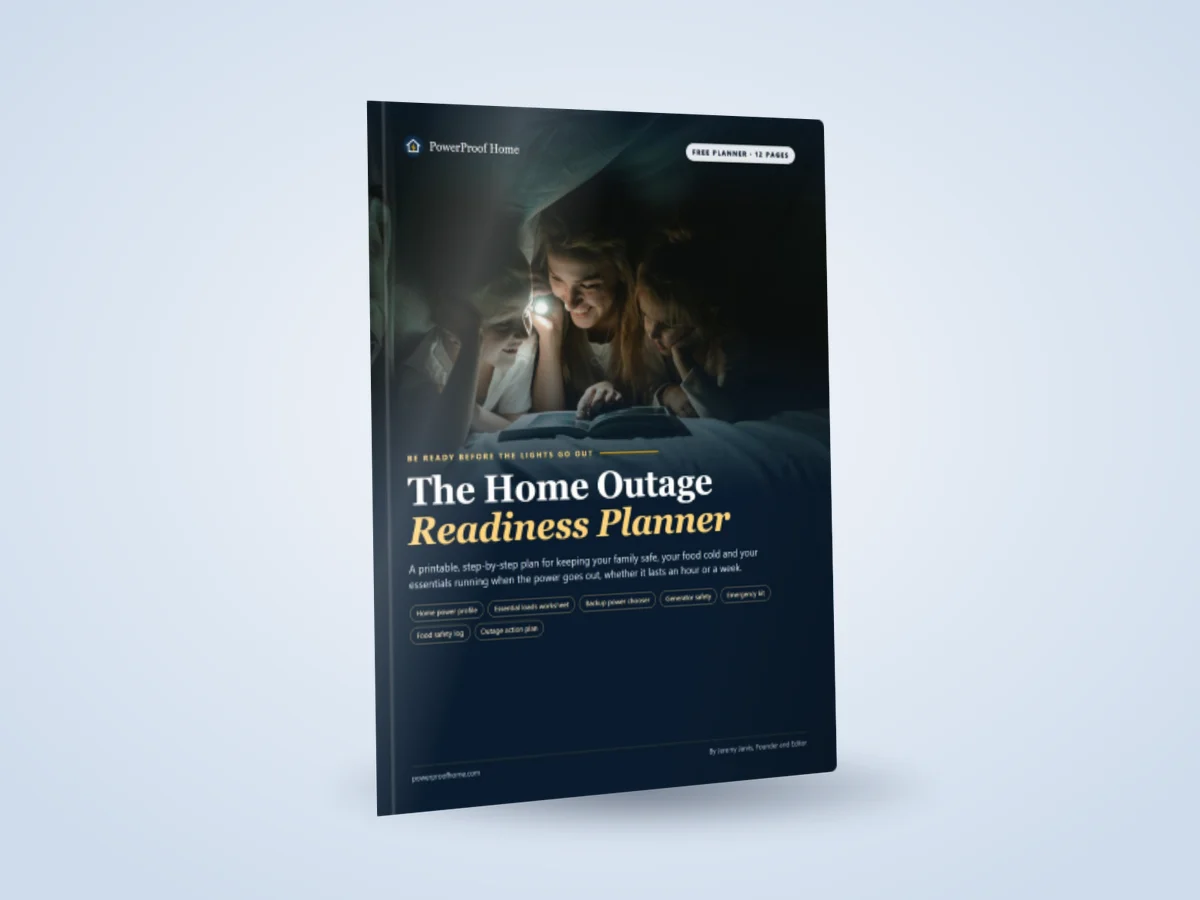
Free download: The Home Outage Readiness Planner
Our 12-page printable planner: a home power profile, essential loads worksheet, backup power chooser, safety rules, emergency kit and food safety log.
Stay informed through a battery-powered or hand-crank radio, especially during storms. Local officials may issue instructions about shelters, water safety or road closures. In addition, conserve your phone battery by lowering brightness and closing apps.
Protect your electronics during a power outage
Power can return with a surge, and surges can damage computers, televisions and appliance control boards. Unplug sensitive electronics until power is stable. Surge protectors help, but unplugging is the simplest protection. Our whole house surge protector guide explains how to protect your whole home.
Food and water
Keep fridge and freezer doors closed. According to the American Red Cross, an unopened refrigerator will keep foods cold for about 4 hours, and a full freezer will keep its temperature for about 48 hours, or 24 hours if half full, if the door remains closed. Eat shelf-stable food first. Our guide to food in a fridge without power explains what to keep and what to throw out.
Water can also be affected. Homes on private wells lose water when the pump loses power. Use stored water for drinking and cooking, and follow any boil-water advisories from local officials. Ready.gov recommends one gallon per person per day for several days in your kit.

Use light safely
Flashlights, headlamps and battery lanterns are the safest light sources during a power outage. Candles cause many home fires during outages. If you use them anyway, never leave them unattended, keep them away from curtains and children, and put them out before sleeping. Similarly, avoid fuel-burning lanterns indoors, because they can produce carbon monoxide.
Staying warm during a power outage
Cold outages need early action, because homes cool quickly. Dress in layers, including hats and socks. Gather everyone in one room, close the doors to unused rooms and cover windows with blankets or heavy curtains at night. Sleeping bags and extra blankets help. Ready.gov’s winter weather guidance warns that winter storms raise the risk of hypothermia and carbon monoxide poisoning.
Never use a gas oven, grill, camp stove or outdoor heater to heat your home. Also, protect pipes from freezing by letting faucets drip if officials advise it. If your home becomes dangerously cold, go to a warming center or a friend’s home with power.
Staying cool in a summer outage
Heat can be just as dangerous. Close blinds and curtains during the day to keep sun out. Stay on the lowest floor, where it is usually coolest. Drink water regularly, even if you are not thirsty. Battery or USB fans help. Watch for signs of heat illness, such as dizziness, headache, nausea or confusion.
Check on neighbors, especially older adults who live alone. If your home becomes too hot, go to a cooling center or a public building with power.
Generator and carbon monoxide safety
Carbon monoxide poisoning is one of the biggest dangers during a power outage. Ready.gov advises that generators, camp stoves and charcoal grills always be used outdoors and at least 20 feet away from windows. Never run them in a home, garage, basement, crawlspace or shed, even with doors open. The EPA warns that deadly levels of carbon monoxide can build up quickly and linger for hours, even after a generator shuts off.
Install battery-powered or battery-backup carbon monoxide alarms on every level of your home. If an alarm sounds, or if anyone feels dizzy, headachy or nauseated, get everyone outside to fresh air and call 911. For more on running a generator safely, read our guide to choosing a generator for home use.

Medical needs
If anyone depends on powered medical equipment, switch to your backup plan right away. Use batteries or a power station, and conserve power by turning off nonessential features where your care team agrees. Our CPAP battery backup guide covers one common case. Keep refrigerated medications in a cooler with ice packs if the outage lasts long. If you cannot maintain power for life-sustaining equipment, seek help or go to a location with power.
Children and pets
Outages can frighten children. Keep routines as normal as possible, and turn the night into a calm activity with flashlights, books and games. Make sure children know not to touch candles, generators or space heaters. For pets, keep food and water available and watch for heat or cold stress.
Downed power lines
Stay far away from downed power lines and anything touching them, such as fences, puddles or vehicles. Assume every downed line is live. Report it to your utility and to 911. Never try to move a line yourself. If a line falls on your car while you are inside, stay in the car unless there is a fire, and call for help.
If the outage lasts for days
Long outages call for a longer plan. Ration fuel, water and phone power. Use daylight hours for cooking and chores. Recharge devices from a power station, solar panels or a car running outdoors. Meanwhile, keep checking official updates for shelters, water advisories and restoration estimates. If conditions become unsafe, leave for a shelter or a friend’s home.
Backup power makes long outages far easier. A portable power station can run a refrigerator, internet and lights. A generator can run more. Our Home Power Plan Builder helps you choose the right option before the next outage.
Garage doors, security systems and sump pumps
Several home systems behave differently during a power outage. Electric garage doors stop working, so learn how to use the manual release before you need it. Many doors have a red cord that disengages the opener, but follow the manufacturer’s instructions, because a door under spring tension can be dangerous. Security systems may run on battery backup for a limited time, so check how long yours lasts.
Sump pumps are especially important in storms. If your basement relies on one, your backup plan becomes urgent when heavy rain coincides with an outage. A battery backup sump pump, a generator or a power station can keep it running. Our sump pump battery backup guide explains the options. Meanwhile, move valuables off the basement floor if water starts to rise.
Working and learning from home during an outage
Many people now work or study from home, so an outage can mean missed deadlines. Plan for it. Keep laptops charged, and keep a power bank that can charge a laptop by USB-C if your model supports it. A portable power station can run a router and a laptop for many hours, which keeps you online if your internet provider’s equipment still has power in your area.
Cell networks may stay up when home internet fails, so a phone hotspot is a useful backup. However, heavy use drains phones quickly. Download what you need in advance, and tell your employer or school about the outage early. Our power station guide helps you size a unit for a home office.
When an outage is forecast
Some outages give warning, such as forecast storms, heat waves or planned wildfire safety shutoffs. Use that time well. Charge phones, power banks and power stations. Fill the freezer with ice or water containers, and turn the fridge and freezer to their coldest safe settings. In addition, fill the car’s tank or charge your EV, because stations and chargers may lose power too.
Then check your kit and backup power. Test the generator outdoors, check fuel and test carbon monoxide alarms. Make sure prescriptions are filled and medical devices are charged. Finally, agree on a family plan, including where to meet and who will check on neighbors.
When the power comes back
When power returns, wait a few minutes before plugging electronics back in. Turn appliances on one at a time to avoid an immediate surge of demand. Check fridge and freezer temperatures before eating anything, and discard perishable food that was above 40 degrees F for two hours or more. Reset clocks, thermostats and medical devices, and check that settings have not changed.
Then restock your kit. Replace used batteries, water and food, recharge power banks and note what worked and what you missed. Our power outage emergency kit guide helps you rebuild it.
What to do during a power outage at a glance
| When | What to do |
|---|---|
| First ten minutes | Flashlight, check neighbors, report outage, unplug electronics, keep fridge closed |
| First few hours | Stay informed, eat shelf-stable food, conserve phone power, check on others |
| After about 4 hours | Move key perishables to a cooler with ice; keep the freezer closed |
| Overnight and beyond | Warmth or cooling plan, safe light, generator outdoors only, CO alarms on |
| Power returns | Restore appliances gradually, check food temperatures, restock the kit |
Power outage safety checklist
- Use flashlights and lanterns instead of candles.
- Report the outage and follow official updates.
- Unplug sensitive electronics; leave one lamp on.
- Keep fridge and freezer doors closed.
- Keep generators, grills and camp stoves outdoors, 20 feet from windows.
- Test carbon monoxide alarms and keep them powered.
- Plan for warmth or cooling early.
- Check on neighbors, children, older adults and pets.
- Stay away from downed power lines.
Be ready for next time
The best time to prepare is before the next outage. Build a kit, plan backup power and test your carbon monoxide alarms. Compare emergency radios, battery carbon monoxide alarms and headlamps. Then explore our Outage Prep hub for the rest of your plan.
Frequently asked questions about what to do during a power outage
What should I do first when the power goes out?
Check whether neighbors also lost power, report the outage to your utility, grab a flashlight, keep the fridge and freezer closed, and unplug sensitive electronics. Then check on everyone in the home.
Should I unplug appliances during a power outage?
Yes for sensitive electronics such as computers and televisions, to protect them from a surge when power returns. Leave one lamp switched on so you know when the power is back.
How long does food stay safe during a power outage?
An unopened refrigerator keeps food cold for about 4 hours. A full freezer holds its temperature for about 48 hours, or 24 hours if half full, if the door stays closed.
Is it safe to use a generator during a power outage?
Yes, if it runs outdoors only, at least 20 feet from windows, doors and vents, and never in a garage, basement or shed. Install battery-backed carbon monoxide alarms inside the home.
How can I stay warm during a winter power outage?
Dress in layers, use blankets and sleeping bags, close off unused rooms, and gather in one room. Never use a gas oven, grill or camp stove to heat your home. Go to a warming center if your home becomes too cold.
Sources and how we researched this guide
This guide is research-based and follows guidance from Ready.gov, the CDC, the American Red Cross and the EPA. We adapted it into a practical sequence; always follow instructions from local officials and your utility during an emergency. Found something out of date? Tell us and we will check it against the source.
- Ready.gov: Power outages
- CDC: What to do during a power outage
- American Red Cross: Power outage safety
- EPA: Carbon monoxide’s impact on indoor air quality
- Ready.gov: Winter weather
Keep planning
- How Long Does Food Last in a Fridge Without Power? Safe Timelines
- Power Outage Emergency Kit: What to Pack and How to Keep It Ready
- CPAP Battery Backup: How to Keep Your CPAP Running in a Power Outage
- Sump Pump Battery Backup: Options, Sizing and Installation Basics
Go deeper: Outage Prep hub · Power Outage Checklist · Power Outage Food Safety Timer
